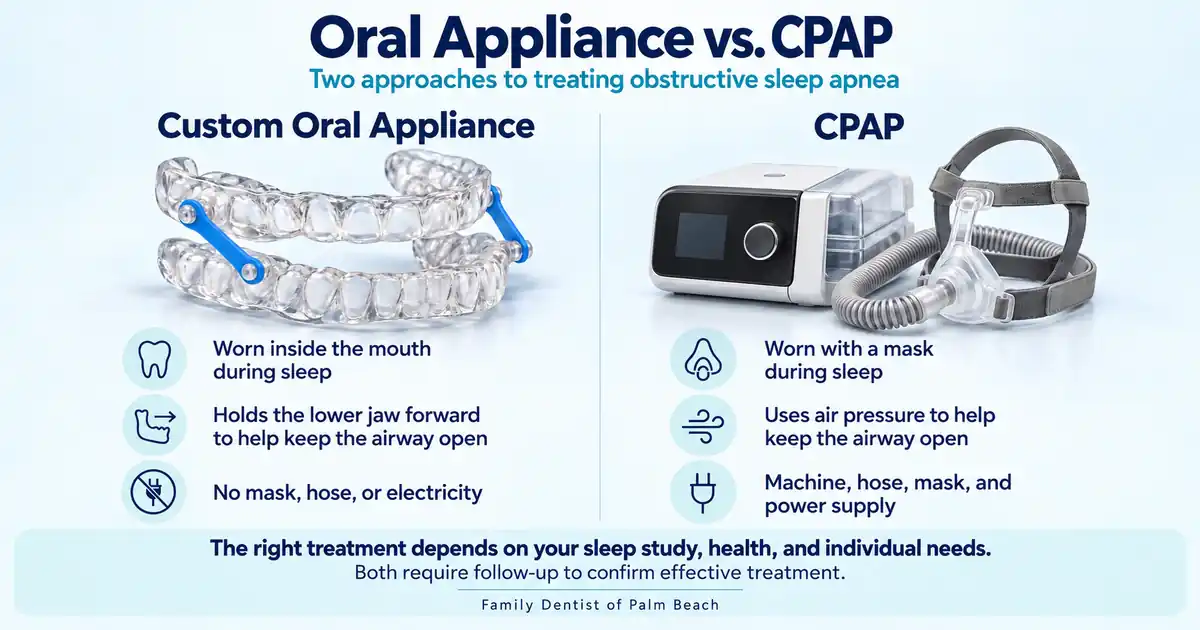
Short answer: for patients who struggle to tolerate CPAP, a custom dental oral appliance — called a mandibular advancement device (MAD) — can be an effective alternative. A study published in The American Journal of Medicine in October 2026 found that an oral appliance produced similar blood pressure control to CPAP in adults with moderate to severe sleep apnea, and patients wore the dental device more consistently each night. CPAP remains the preferred first-line treatment for moderate to severe cases, but the evidence for oral appliances continues to strengthen.
Why so many people struggle with CPAP
CPAP — continuous positive airway pressure — is the most studied treatment for moderate to severe sleep apnea. It works by delivering a steady stream of pressurised air through a mask, holding the airway open while you sleep. For patients who tolerate it well and use it every night, the results can be excellent.
The problem is consistent use. Studies suggest that up to half of CPAP users do not use their device as recommended — generally defined as at least four hours a night on at least 70 percent of nights. The mask is uncomfortable. The hose gets in the way. Some people find the pressure claustrophobic; others simply cannot sleep with the noise. A treatment that works in the clinic only works in real life if people actually use it.
This is where oral appliance therapy enters the conversation. It has fewer barriers to use: it is small, silent, portable, and requires no electricity. The long-standing question has been whether it works as well.
What the October 2026 study found: in a 12-month randomised trial of 180 adults with moderate to severe sleep apnea and high blood pressure, patients assigned to a custom oral appliance wore it a median of 5.5 hours per night — compared with 4.9 hours for CPAP users. Blood pressure control was similar between the two groups, and both treatments reduced daytime sleepiness and unplanned hospitalisations. Source: The American Journal of Medicine, October 2026 (summarised by Harvard Health).
What the study measured — and what it did not
The study enrolled 180 adults with moderate to severe sleep apnea and elevated blood pressure, randomly assigning them to CPAP or a custom mandibular advancement device for 12 months. The primary outcome was blood pressure control — not the total elimination of apnea events, which is the more traditional measure of sleep-apnea treatment effectiveness.
CPAP generally reduces the number of apnea events per hour (the apnea-hypopnea index, or AHI) more than an oral appliance does. But the study suggests that for at least one clinically important outcome — blood pressure — the performance gap between the two devices may be partly offset by the difference in how consistently patients use each one. A device worn five and a half hours a night may produce better real-world results than a device worn fewer than five, even if the latter is more effective while in use.
The authors are careful to note that CPAP remains the standard of care, particularly for severe sleep apnea or when there are serious cardiovascular concerns. This is one study with 180 participants and a specific primary outcome. It adds meaningful weight to an already-supported treatment option — it is not a reason to switch every patient off CPAP.
How a mandibular advancement device works
A MAD is custom-fabricated from impressions of your teeth and jaw. It fits over your upper and lower teeth — similar in feel to a sports mouthguard — and uses a small hinge or adjustment mechanism to hold your lower jaw (mandible) in a slightly forward position while you sleep.
That forward jaw position tightens the soft tissue and muscles at the back of the throat, which helps keep the airway open and reduces or eliminates the collapses that cause apnea events. It does not deliver pressurised air the way CPAP does. What it can do, for the right patient, is meaningfully reduce the frequency and severity of those collapses.
Fitting is done by a dentist with training in dental sleep medicine, working in coordination with your physician or sleep specialist. Your physician orders the sleep study that establishes your diagnosis; the dentist fabricates and titrates the appliance; follow-up testing confirms whether it is doing its job. The two care teams stay in communication throughout.
Who tends to be a good candidate
Oral appliances tend to work best for patients with mild to moderate sleep apnea, though they are used for more severe cases when CPAP is not a workable option. Factors that may make someone a stronger candidate include:
- A history of CPAP intolerance or poor adherence despite troubleshooting
- Predominantly positional sleep apnea (events worse when sleeping on the back)
- Jaw anatomy that responds well to forward positioning
- Travel, lifestyle, or occupation factors that make a CPAP machine impractical
Patients with very severe sleep apnea, significant central (non-obstructive) sleep apnea, or certain jaw joint conditions may not be good candidates. Only a proper evaluation — including a review of your sleep study results — can determine whether an appliance is appropriate for your situation. We are happy to discuss that with you.
What CPAP does that an oral appliance cannot
It is worth being direct about the trade-offs. CPAP is generally more reliable at bringing down the AHI, particularly in severe sleep apnea. If your physician has recommended CPAP, that recommendation is usually well-founded, and it is worth working through the adjustment period rather than abandoning the device prematurely.
Common CPAP difficulties — dry mouth, nasal congestion, mask fit problems, pressure discomfort — often have practical solutions: a different mask style, a humidifier attachment, a different pressure setting, or a switch to BiPAP or APAP. If you have only tried one CPAP setup and found it intolerable, it may be worth going back to your sleep specialist before concluding CPAP is not for you.
An oral appliance is a medically recognised treatment, not a workaround. But choosing between them is a clinical decision, not a consumer preference, and it should be made with your physician and dentist working together.
If you are managing jaw-related concerns alongside sleep apnea — clicking, facial pain, or morning headaches — our TMJ & Sleep Center evaluates both at the same appointment. There is significant overlap between TMJ dysfunction and sleep-disordered breathing, and addressing them together often produces better outcomes than treating each in isolation.
For a full overview of what we offer for sleep-disordered breathing, see our sleep apnea treatment page.
Tired of fighting your CPAP every night?
A custom oral appliance may be a clinically effective alternative for some patients. Bring your sleep study results and we will walk through your options together — no pressure, no sales pitch.
Frequently Asked Questions
Can a dental appliance really replace my CPAP for sleep apnea?
For some patients, yes. A study published in The American Journal of Medicine in October 2026 found that a custom mandibular advancement device provided similar blood pressure control to CPAP in adults with moderate to severe sleep apnea over 12 months. CPAP is still the preferred first-line treatment, particularly when cardiovascular risk is high — but an oral appliance is a clinically recognised alternative, especially for patients who cannot tolerate CPAP consistently. Whether it is right for you depends on the severity of your apnea, your anatomy, and your specific health profile.
What is a mandibular advancement device and how does it work?
A mandibular advancement device is a custom-fitted appliance that looks like a sports mouthguard. It fits over your upper and lower teeth and uses small hinges or a screw mechanism to gently move your lower jaw forward while you sleep. This forward position tensions the soft tissue and muscles at the back of the throat, keeping the airway open and reducing the collapses that cause sleep apnea events. A dentist trained in dental sleep medicine takes impressions of your teeth and jaw to fabricate an appliance that fits precisely — over-the-counter devices are not equivalent.
How do I know if I have sleep apnea?
Common signs include loud or disruptive snoring, waking with a dry mouth or headache, feeling unrefreshed after a full night of sleep, daytime fatigue or difficulty concentrating, and being told by a partner that you stop breathing briefly during sleep. However, many people with sleep apnea have no obvious symptoms and attribute their tiredness to other causes. Diagnosis requires a sleep study ordered by your physician. If any of these signs sound familiar, speak with your doctor or ask us about a referral.
What are the side effects of a sleep apnea oral appliance?
The most common side effects are temporary jaw soreness or stiffness when you first start using the device, excess saliva production, and mild tooth discomfort. These typically settle within the first few weeks as you adjust. Some patients notice minor changes in their bite over time that are usually correctable with simple morning jaw exercises. A properly fitted and regularly followed-up appliance should not cause permanent bite changes — which is why regular dental check-ins matter.
Is an oral appliance covered by insurance for sleep apnea?
Coverage varies by plan and diagnosis. Many medical insurance plans (not dental plans) cover oral appliance therapy for sleep apnea when there is a documented diagnosis from a sleep study and a physician referral. We recommend calling your medical insurer before your appointment to ask about your specific benefits. Our team can help you understand the process and provide the clinical documentation your insurer may require.
This article is for general educational purposes and is not a substitute for professional medical or dental advice, diagnosis, or treatment. Sleep apnea is a medical condition that requires diagnosis by a licensed physician using a sleep study. If you think you may have sleep apnea, or if you are considering changing your current treatment, please consult your physician and dentist before making any changes.
Related: Sleep Apnea Treatment · TMJ & Sleep Center · TMJ Pain Relief · Book a Consultation